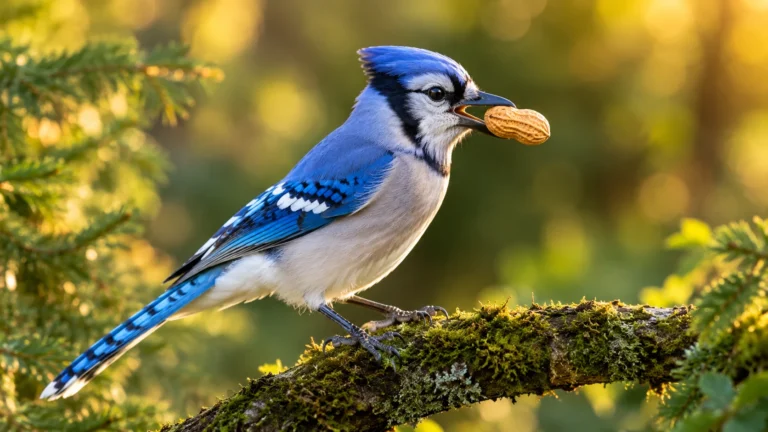
The Blue Jay (Cyanocitta cristata) is a large, highly intelligent songbird native to eastern and central North America. A member of the Corvidae family—which includes crows and ravens—the Blue Jay is renowned for its striking blue plumage, loud vocalizations, and complex social behaviors. Because they are bold, curious, and resourceful, Blue Jays are a prominent fixture in American backyards, forest edges, and oak groves throughout the year.
Blue Jay Quick Facts
| Common Name | Blue Jay |
| Scientific Name | Cyanocitta cristata |
| Size & Length | 9.8 to 11.8 inches |
| Wingspan | 13.4 to 16.9 inches |
| Weight | 2.5 to 3.5 ounces |
| US Range | Eastern and Central US, expanding into the Northwest |
| Migration | Complex / Partially migratory |
| Conservation Status | Stable / Lowest Concern |
How to Identify Blue Jays
Blue Jays are easily recognized by their size and distinct color patterns, though their structural features are equally diagnostic.
Size and Shape
The Blue Jay is a large, robust songbird, noticeably larger than a Northern Cardinal but smaller than an American Crow. It possesses a heavy, stout bill adapted for cracking hard nuts and acorns. The most prominent structural feature is its conspicuous head crest, which moves up and down depending on the bird’s mood: raised high when excited or aggressive, and flattened against the head when feeding or resting among other jays.
Plumage and Coloration
Unlike many bird species, male and female Blue Jays look exactly alike.
- Upperparts: The back and wings are covered in various shades of lavender-blue, mid-blue, and bright sky blue.
- Underparts: The chest, belly, and throat are off-white or light gray.
- Markings: A bold, jet-black collar runs down the sides of the head and across the throat, forming a distinct U-shaped necklace. The wings and tail are intricately barred with black and highlighted by prominent white patches.
- The Blue Illusion: Interestingly, Blue Jay feathers do not actually contain blue pigment. The blue color is a structural color caused by light scattering (Tyndall scattering) through the microscopic structure of the feather cells. If you crush a Blue Jay feather, the blue color disappears entirely, leaving only gray or brown melanin.
Habitat and Range
Blue Jays occupy a vast geographical range that covers the entire eastern half of the United States, stretching across the Great Plains to the eastern Rocky Mountains, and up into southern Canada. In recent decades, they have steadily expanded their range northwestward into parts of Idaho, Washington, and Oregon.
Their primary habitats include:
- Deciduous, coniferous, and mixed forests—particularly those with oak and beech trees.
- Suburban residential neighborhoods, city parks, and heavily landscaped yards.
- Forest edges where open spaces meet dense treelines.
Migration Mysteries
Blue Jay migration remains poorly understood by ornithologists. While the species is considered a year-round resident across most of its range, some populations migrate south along the Atlantic coast and Great Lakes in massive flocks. Individual behavior is unpredictable: a single Blue Jay may migrate one year, stay put the next winter, and then migrate again the following year.
Diet and Ecological Role
Blue Jays are highly omnivorous and opportunistic feeders. Their natural diet shifts with seasonal availability:
- Vegetable Matter (approx. 75%): Acorns, beech nuts, hickory nuts, wild berries, seeds, and cultivated grains.
- Animal Matter (approx. 25%): Beetles, grasshoppers, caterpillars, spiders, snails, small frogs, and carrion.
Cache Behavior and Forest Regeneration
Blue Jays are obsessive “cachers.” In the autumn, a single Blue Jay can harvest and bury between 3,000 and 5,000 acorns to store as a winter food source. They use their expandable throat pouch to transport up to five acorns at a time. Because they forget the locations of many buried nuts, Blue Jays act as primary drivers of forest regeneration, effectively planting thousands of oak trees across North America every year.
How to Attract Blue Jays to Your Backyard
Because Blue Jays are large, gregarious birds, traditional small tube feeders will not accommodate them. To attract them consistently, adjust your setup to handle their size and dietary preferences.
1. Install Heavy Platform or Tray Feeders
Blue Jays prefer a solid, flat surface where they can land confidently and hammer open tough seeds.
- Best Feeders: Large, open platform feeders, hanging tray feeders, or heavy-duty hopper feeders.
- Ground Feeding: They will readily feed on low platforms or large flat stones placed near the edge of a lawn.
2. Offer Whole Peanuts
If you want to attract Blue Jays instantly, offer whole peanuts in the shell. They will fly in, weigh each peanut with their beak to find the heaviest one, and fly off to cache or eat it.
- Other Top Foods: Striped sunflower seeds, black oil sunflower seeds, suet blocks, and mealworms.
3. Provide Substantial Birdbaths
Due to their size, Blue Jays require deeper water than smaller finches or chickadees. A sturdy, concrete birdbath filled with 2 to 3 inches of clean water will attract them for daily bathing rituals.
Behavior and Vocalizations
Hawk Mimicry and Sentinel Role
Blue Jays are famous for mimicking the calls of hawks, particularly the Red-shouldered Hawk and Red-tailed Hawk. They use these deceptive calls to test if a predator is nearby, or to scare other birds away from a bird feeder so they can eat alone.
Because they scream loudly whenever they spot an owl, hawk, or outdoor cat, Blue Jays serve as the “sentinels” of the woods, alerting all nearby wildlife to potential danger.
Complex Social Structure
Corvids operate within tight-knit family structures. Blue Jays form monogamous pairs that often stay together for life. They work together to build open-cup nests made of twigs, bark, and roots, typically high in the fork of a deciduous tree. During the nesting phase, they become incredibly quiet and secretive to avoid drawing attention to their eggs and chicks.