The California Condor (Gymnogyps californianus) is the largest land bird in North America. A member of the Cathartidae family (New World vultures), this massive, Pleistocene-era scavenger is one of the rarest bird species on Earth. In 1987, facing total extinction, the remaining 27 wild individuals were captured for an intensive federal captive breeding program. Thanks to decades of reintroduction efforts, these majestic giants once again soar over the rugged canyons of the American West, representing a monumental triumph in modern conservation biology.
California Condor Quick Facts
| Common Name | California Condor |
| Scientific Name | Gymnogyps californianus |
| Size & Length | 43 to 53 inches |
| Wingspan | 9.0 to 9.8 feet |
| Weight | 15.4 to 31.0 pounds |
| US Range | Localized in California, Arizona, Utah, and the Pacific Northwest |
| Migration | Non-migratory (Wanders extensively within home range) |
| Conservation Status | Critically Endangered (Population strictly managed) |
How to Identify California Condors
The sheer size of a California Condor is its most immediate identifier. In the air, they are often mistaken for small airplanes or eagles, but their structural profile is entirely unique.
Flight Silhouette and Mechanics
With a wingspan nearly reaching 10 feet, condors are master gliders. They can travel miles without flapping their wings a single time.
- The Flat Wing Profile: Unlike Turkey Vultures, which fly with their wings tilted upward in a distinct V-shape (dihedral) and rock unstably in the wind, California Condors hold their massive wings perfectly flat and straight.
- Finger-like Primaries: In flight, the long flight feathers at the tips of their wings spread out widely, resembling open fingers designed to catch thermal updrafts.
Adult vs. Juvenile Plumage
Like many long-lived species, condors require several years to achieve full adult coloration.
- Adults (6+ Years): The body is covered in uniform, matte-black feathers. The head and neck are completely featherless, revealing bare skin that ranges from pinkish-yellow to brilliant orange. Their most diagnostic flight mark is a broad, striking triangular white patch underneath the front edge of each wing (the linings).
- Juveniles (1–5 Years): Display a much darker, muted appearance. Their bodies are dusky black, their heads are covered in dark gray skin, and the underwing linings are mottled gray rather than clean white.
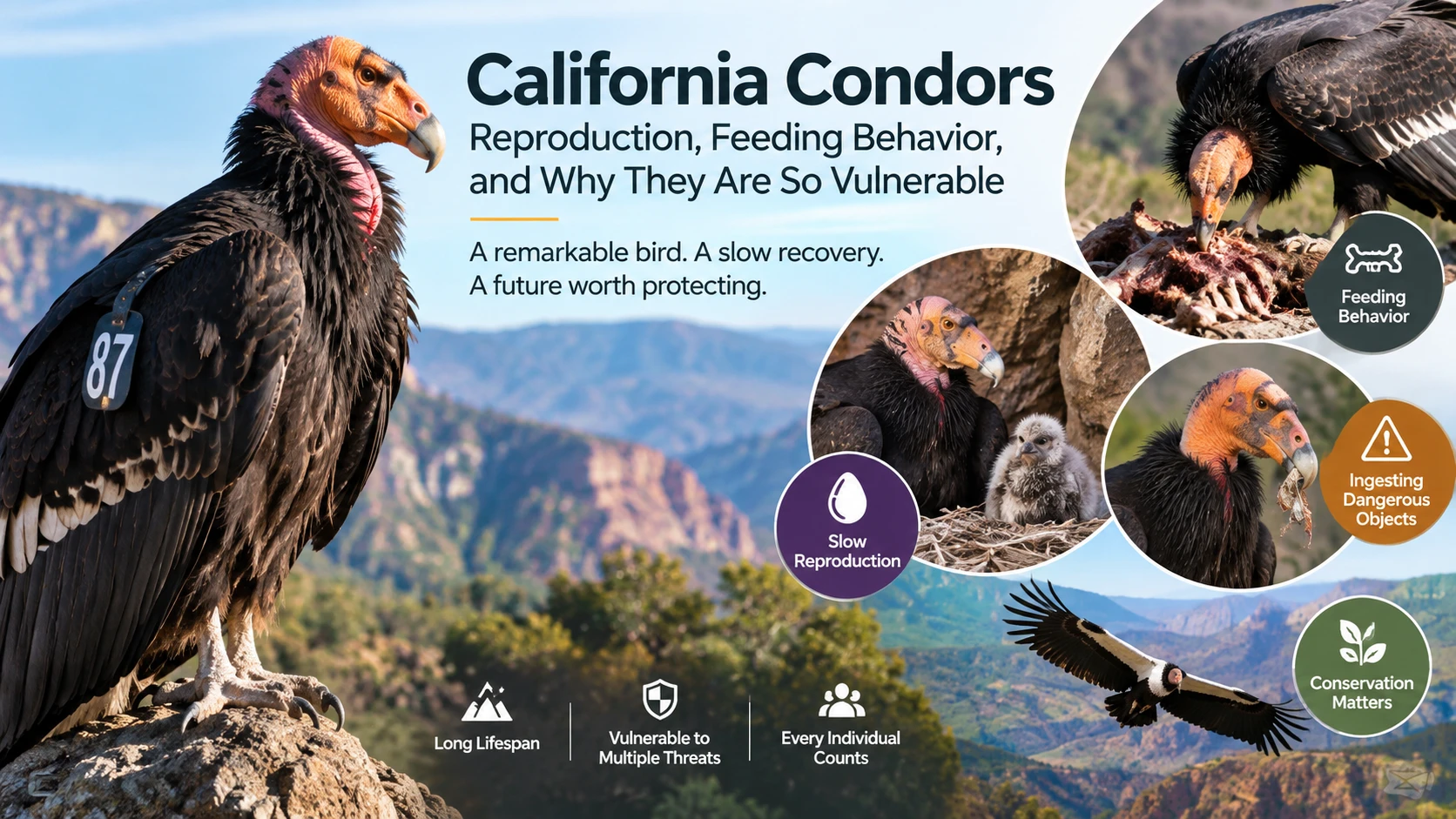
Identifying Wild Markers: Because every individual wild condor is intensely monitored by biologists, almost every bird you see in the wild will sport a large, brightly colored plastic wing tag featuring a prominent tracking number. Many also carry visible radio or satellite telemetry units attached to their feathers.
Habitat and U.S. Range
California Condors require vast, uninterrupted landscapes that provide dramatic topographical changes. They rely on thermal air currents generated by heat rising off canyon walls or mountain ridges to stay aloft.
Their highly localized habitats include:
- Gargantuan rocky canyons, gorges, and mountain cliffs for nesting and roosting safely away from land predators.
- Oak savannahs, open foothills, and large coastal grasslands for foraging.
Current Wild Populations
Following successful reintroduction programs run by the US Fish and Wildlife Service, National Park Service, and the Peregrine Fund, managed wild populations exist in three distinct regions:
- California: The rugged coastal mountains of Big Sur, Pinnacles National Park, and the mountains bordering the southern San Joaquin Valley.
- The Southwest: The cliffs surrounding the Grand Canyon, Vermilion Cliffs National Monument in Arizona, and Zion National Park in Utah.
- The Pacific Northwest: A newly established reintroduction site managed by the Yurok Tribe in redwood country along the northern California coast.
Diet and Scavenging Ecology
California Condors are strict, obligate scavengers. They do not possess the sharp, gripping talons of eagles or hawks and are completely incapable of killing their own prey. Instead, they perform a vital ecological cleanup role by consuming carrion.
Foraging Habits
Condors use their incredible eyesight rather than a sense of smell to locate food from thousands of feet in the air. They routinely look for aggregations of ravens or Turkey Vultures gathered around a carcass, then swoop down to displace the smaller birds using their massive size.
Their diet focuses heavily on large mammal carcasses:
- Inland: Deer, elk, wild cattle, sheep, and pigs.
- Coastal: Marine mammals, including washed-up whale carcasses, sea lions, elephant seals, and large fish.
Because their large, hooked beaks are incredibly strong, they can rip through tough hides that smaller scavengers cannot penetrate, facilitating access to food for the entire ecosystem.
Threats and Conservation Realities
The California Condor population hit an all-time low of just 22 wild birds in the mid-1980s. While captive breeding has raised total populations back above 500 birds (with over 300 in the wild), their survival remains heavily dependent on human intervention due to modern environmental hazards.
1. Lead Poisoning (The Primary Threat)
Lead poisoning remains the single greatest cause of death for wild condors. When hunters shoot big game with traditional lead ammunition, the bullet fragments into hundreds of tiny pieces inside the animal. If the field dressing (gut pile) is left behind or the animal is not retrieved, condors consume the meat along with the toxic lead fragments. Their highly acidic stomach juices dissolve the lead rapidly, causing paralysis of the digestive tract, starvation, and a slow death.
The Solution: Biologists routinely capture wild condors to test their blood copper and lead levels. Birds with severe poisoning undergo intensive chelation therapy to strip lead from their bloodstreams. Conservation groups strongly advocate for hunters to switch to non-toxic, solid copper ammunition, which does not fragment upon impact.
2. Microtrash Ingestion
Nesting condor parents exhibit a bizarre behavior where they collect small, shiny objects—such as bottle caps, broken glass, pull-tabs, and bullet casings—and feed them to their nestlings. The chicks cannot pass these indigestible items, leading to intestinal impaction and mortality unless manually removed by veterinary teams.
3. Highly Specialized Reproduction
Condors reproduce at an exceptionally slow biological rate. They do not reach sexual maturity until age six, pair for life, and lay only a single egg every two years. The parents incubate the egg for 56 days, and the chick requires over six months of parental care before it can even leave the nesting cave. This slow turnaround means wild populations cannot recover quickly from adult mortality.
Frequently Asked Questions (FAQs)
1. How long do California condors live?
California condors can live for 50 years or more, making them one of the longest-lived birds in North America.
2. Why are California condors endangered?
California condors have faced threats including lead poisoning, habitat loss, and human-related hazards. Conservation programs continue to protect and rebuild their populations.
3. What do California condors eat?
California condors are scavengers that primarily eat dead animals (carrion), especially the remains of large mammals.
4. How often do California condors lay eggs?
A female California condor generally lays one egg at a time, and successful breeding may occur about every two years.
5. How long does a California condor egg take to hatch?
The egg is incubated for approximately 56 days before it hatches.
6. At what age do California condors start breeding?
California condors typically reach sexual maturity at around six years of age, although individual birds can vary.
7. How big is a California condor?
California condors are among the largest flying birds in North America, with a wingspan that can reach approximately 9.5 feet (2.9 meters).
8. Where do California condors live?
Wild California condors are found in parts of California, Arizona, and Baja California, Mexico, where conservation programs support their recovery.
9. Why do California condors reproduce so slowly?
They mature relatively late, usually produce only one egg, and require extensive parental care. This means their population cannot increase rapidly.
10. How many California condors are left?
The number changes as birds are born, die, released, or move between wild and managed populations, so current population figures should be checked against the latest official conservation data.