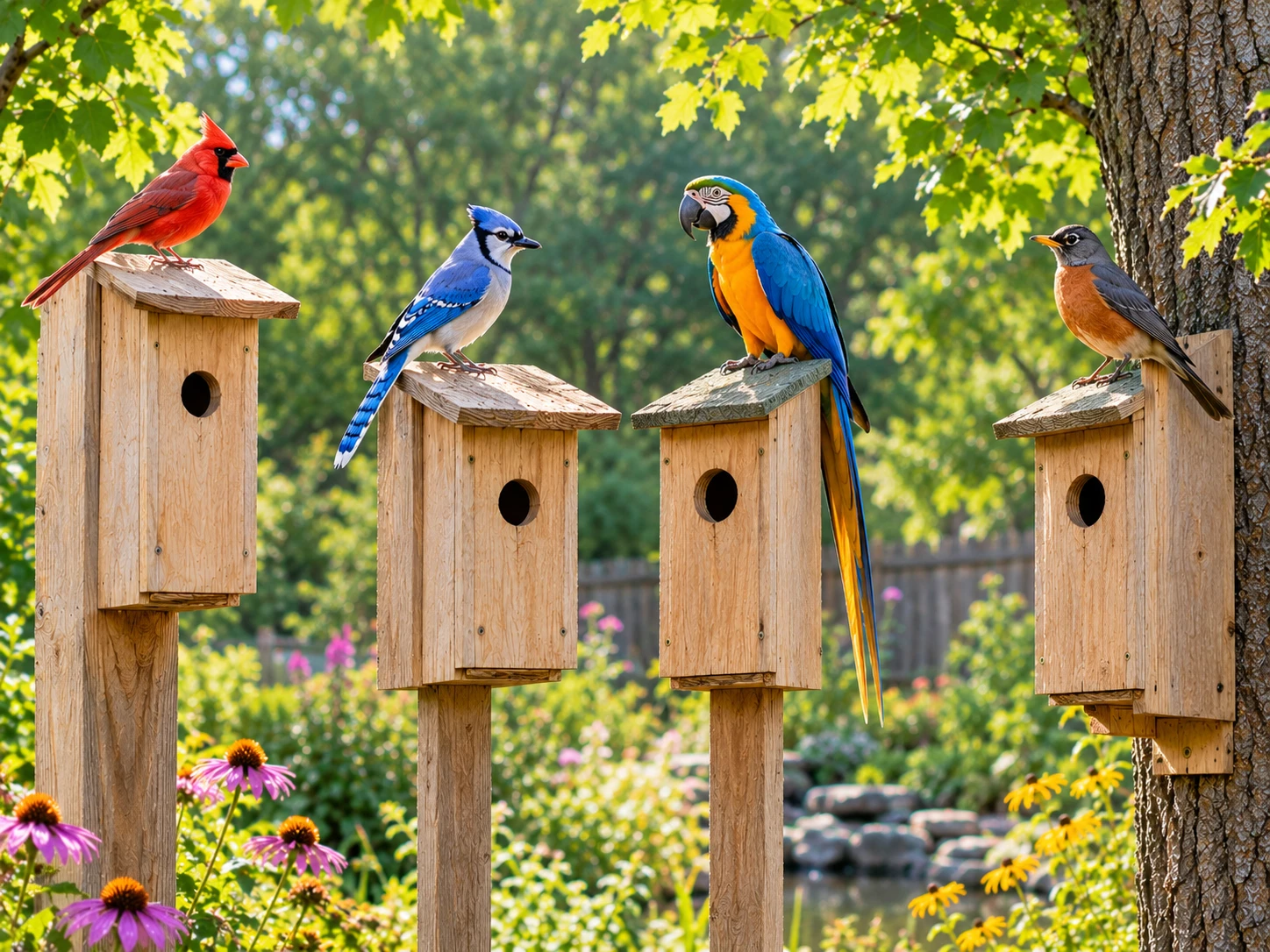
Providing artificial nesting cavities—commonly called birdhouses or nest boxes—is a practical way to support cavity-nesting birds in backyards across the United States.
But there is no true “one-size-fits-all” birdhouse. Different species need different entrance-hole sizes, interior dimensions, mounting heights, and habitat conditions.
A box that works well for an Eastern Bluebird may not be suitable for a chickadee, wood duck, or screech-owl. Choosing the right design helps you attract the species you actually want to see.
🪶 Quick Tip for Backyard Birders
Before buying or building a nest box, ask three questions:
- Which bird species am I trying to attract?
- What entrance-hole size does it need?
- Where should the box be placed for that species?
Getting these three things right can make your nest box much more useful.
Universal Nest Box Engineering Standards
Before looking at species-specific dimensions, every quality nest box should include several basic features that improve durability, drainage, ventilation, and bird safety.
Use Suitable, Untreated Wood
Use naturally durable wood such as western red cedar, redwood, or cypress.
Avoid materials that may not be appropriate for outdoor birdhouses, especially treated lumber or construction materials that can deteriorate or expose birds to unwanted chemicals.
Use Thick Walls
Wood around 3/4 inch thick provides useful insulation against temperature changes.
This is especially important because nest boxes can become surprisingly hot when exposed to direct summer sunlight.
Skip the Perch
Do not add a perch below the entrance hole.
Most cavity-nesting birds do not need one. A perch can also provide an easier foothold for some predators.
🚫 Perch or No Perch?
No perch is usually the better choice.
Native cavity-nesting birds can grip the rough wood around the entrance. A perch isn’t necessary for them to enter the box.
Add Drainage and Ventilation
Good drainage prevents water from collecting inside the box.
Consider adding:
- Four small drainage holes in the floor
- Ventilation openings near the upper portion of the box
- A roof with enough overhang to help protect the entrance from rain
The exact design can vary depending on the species and climate.
Make the Interior Easy for Fledglings to Climb
The inside of the front panel below the entrance should provide enough texture for young birds to grip.
You can create shallow horizontal grooves in the wood rather than leaving the surface completely smooth.
Nest Box Dimension Blueprints by Species
The right dimensions depend heavily on the species you want to attract.
| Target Species | Entrance Hole | Floor Size | Interior Depth | Hole Above Floor | Typical Mounting Height |
|---|---|---|---|---|---|
| Eastern Bluebird | 1.50 in | 5 × 5 in | 8–10 in | 6 in | 4–6 ft |
| Western / Mountain Bluebird | 1 9/16 in | 5 × 5 in | 8–10 in | 6 in | 4–6 ft |
| Carolina / Black-capped Chickadee | 1 1/8 in | 4 × 4 in | 8–10 in | 6–8 in | 5–15 ft |
| Tufted Titmouse | 1 1/4 in | 4 × 4 in | 8–10 in | 6–8 in | 5–15 ft |
| White-breasted Nuthatch | 1 1/4 in | 4 × 4 in | 8–10 in | 6–8 in | 12–20 ft |
| House Wren | 1 1/8 in | 4 × 4 in | 6–8 in | 4–6 in | 4–10 ft |
| Tree Swallow | 1.50 in | 5 × 5 in | 6–8 in | 4–6 in | 5–6 ft |
| Downy Woodpecker | 1 1/4 in | 4 × 4 in | 8–10 in | 6–8 in | 5–15 ft |
| American Kestrel | 3.00 in | 8 × 8 in | 12–15 in | 9–12 in | 10–30 ft |
| Eastern/Western Screech-Owl | 3.00 in | 8 × 8 in | 12–15 in | 9–12 in | 10–30 ft |
| Wood Duck | 4 × 3 in oval | 10 × 10 in | 15–24 in | 12–16 in | 4–20 ft |
📏 Don’t Guess the Entrance Hole
The entrance hole is one of the most important measurements on a nest box.
Too small: your target bird may not be able to enter.
Too large: larger birds may gain access, potentially creating competition for the intended species.
If you’re building a box, measure the entrance carefully and use species-specific dimensions rather than guessing.
How to Choose the Right Nest Box
If you’re new to nest boxes, don’t start by asking, “What is the best birdhouse?”
Instead, start with:
“Which bird do I want to attract?”
Then choose the box dimensions, entrance hole, habitat, and mounting location around that species.
This simple approach makes the entire process easier.
Detailed Species Construction Tips
1. Small Songbirds: Chickadees, Titmice, and Wrens
Small cavity-nesting birds have different preferences from larger species.
Chickadees, for example, may use boxes containing suitable nesting material or substrate. Follow the recommendations for the specific species and local birdhouse program you’re using.
💡 Backyard Tip
If you’re installing your first nest box, choose one target species rather than trying to attract every cavity-nesting bird at once.
A species-specific box is easier to place, monitor, and maintain.
2. Bluebirds
Bluebirds are popular nest-box birds throughout much of the United States.
For an Eastern Bluebird box, a 1.5-inch entrance hole is commonly used.
Keep the entrance size accurate, and inspect the box periodically for damage or enlargement.
3. American Kestrels and Screech-Owls
Larger cavity-nesting birds need substantially larger boxes than songbirds.
Their boxes should be placed in suitable habitat and at an appropriate height for the target species.
For these species, follow established nest-box plans rather than relying on a generic birdhouse design.
4. Wood Ducks
Wood Duck boxes require a different approach because they are often installed near wetlands, ponds, rivers, or other suitable habitat.
Because ducklings must leave a relatively deep cavity after hatching, the box should include an appropriate interior surface or ladder that allows them to reach the entrance.
Predator Deterrence and Mounting Systems
Where you install a nest box matters almost as much as the box itself.
Avoid placing a box where nearby trees, fences, branches, or structures provide an easy route for climbing predators.
The Metal Pole and Baffle Approach
One effective way to reduce climbing-predator access is to mount a nest box on a smooth metal pole with a properly installed predator baffle.
A typical setup may include:
- A sturdy galvanized metal pole
- A smooth predator baffle below the box
- Adequate clearance from nearby trees and structures
- Secure mounting so the box remains stable
🛡️ Predator Protection Checklist
Before installing your box, stand back and look at the entire area.
Can a squirrel climb from a tree to the box?
Can a raccoon reach it from a fence?
Is there a branch close enough to provide access?If the answer is yes, change the placement or improve the protection.
No baffle or mounting method can guarantee complete predator protection, so placement should always be considered as part of the overall design.
Which Direction Should a Birdhouse Face?
There is no universal direction that works for every backyard.
East or southeast may work well in some locations, but your local weather conditions are more important than following a fixed compass direction.
Consider:
- Prevailing wind
- Driving rain
- Summer heat
- Afternoon sunlight
- Shade
- Nearby vegetation
- Local habitat conditions
The goal is to give the box reasonable protection from severe weather while keeping the entrance accessible.
☀️ Easy Placement Rule
Don’t worry about finding a “magic” direction.
Instead, choose a location that provides good habitat, reasonable shade, protection from harsh weather, and distance from predator access points.
Find the Right Nest Box Dimensions for Your Bird
Different species need different entrance holes, floor sizes, depths, and mounting heights. Instead of guessing, use species-specific measurements before building or buying your box.
🏠 Building a Birdhouse?
Get the exact entrance-hole size, floor dimensions, box depth, and recommended mounting height for 23 bird species with our Birdhouse Dimensions Calculator.
Open the Birdhouse Dimensions Calculator →
🐦 Start With the Bird, Not the Box
The best nest box isn’t simply the biggest, strongest, or most expensive one.
It’s the box designed for the species you’re trying to attract.
Choose the species first → check its dimensions → select the right habitat → install the box safely.