
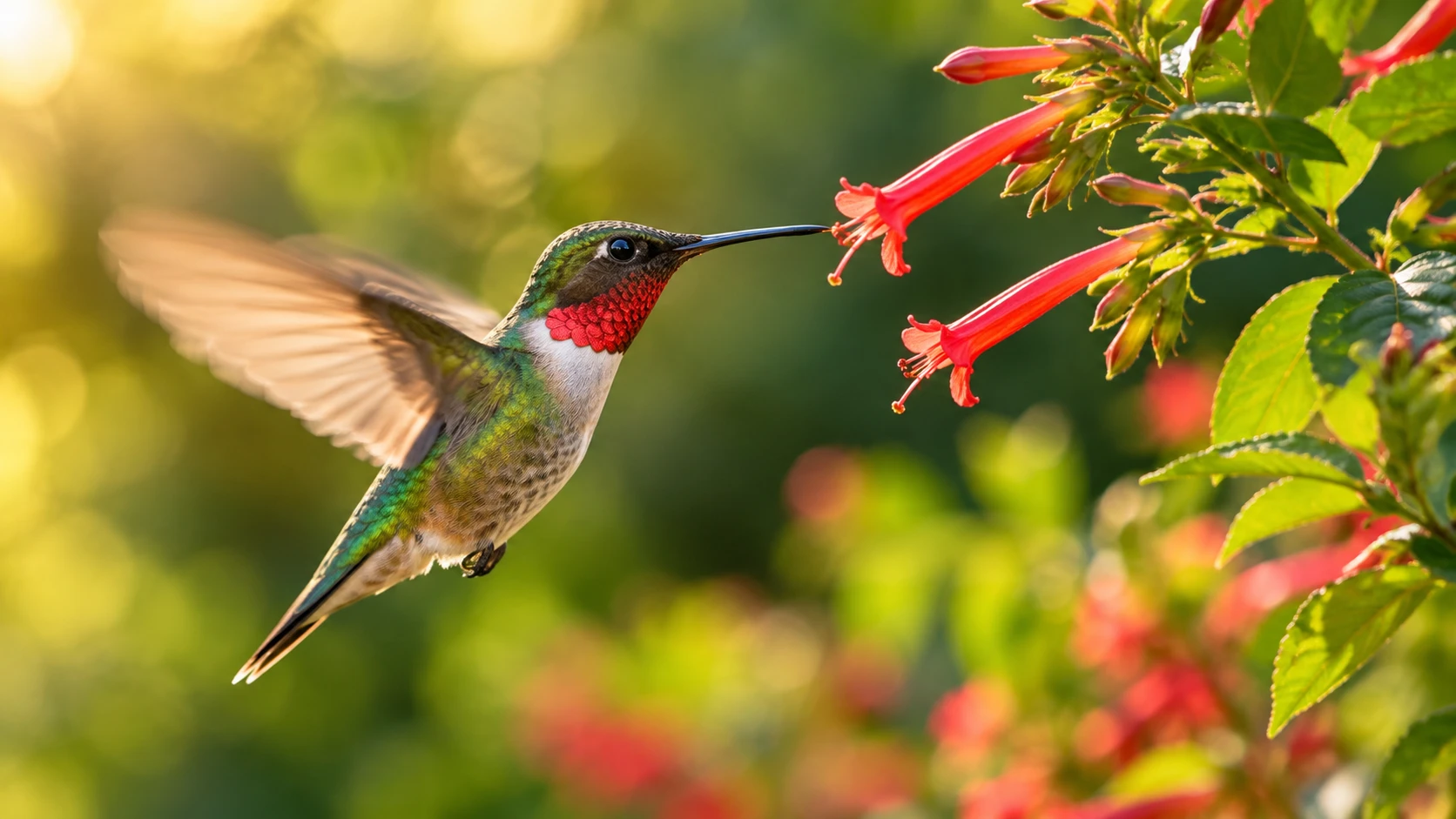
Hummingbirds may be tiny, but many travel thousands of miles during their annual migrations. Their arrival and departure dates vary by species, location, weather, and food availability.
Use our Hummingbird Migration Map to explore migration patterns across the United States and learn when hummingbirds may arrive in your area.
Whether you’re watching Ruby-throated Hummingbirds in the East or western species such as Anna’s and Allen’s Hummingbirds, understanding seasonal movement can help you know when to watch, when to put out feeders, and what species you may see.
🗺️ How Hummingbird Migration Works
Hummingbird migration is not exactly the same across the United States. Different species follow different routes and schedules.
In the eastern United States, the Ruby-throated Hummingbird is the only hummingbird species that regularly breeds in eastern North America. Many Ruby-throated Hummingbirds spend the winter in Mexico and Central America before returning north in spring.
In the western United States, several hummingbird species have different migration patterns. Some western hummingbirds can begin their southbound movement during the summer rather than waiting until the traditional fall migration period.
Typical Hummingbird Migration Seasons
| Season | Typical timing | What to expect |
|---|---|---|
| Spring migration | March–May in many areas | Hummingbirds move north toward breeding areas |
| Summer | May–August | Many species are on breeding grounds or remain year-round |
| Fall migration | July–October, depending on species and location | Many migratory hummingbirds move south |
| Winter | Varies by species | Many species spend winter farther south; some remain in parts of the U.S. |
Important: These are general patterns, not exact arrival dates. Migration timing can vary considerably by species and location.
🐦 Ruby-throated Hummingbird Migration
The Ruby-throated Hummingbird is one of the most important species to watch during hummingbird migration in the eastern United States.
In spring, Ruby-throated Hummingbirds begin moving north from their wintering areas. Audubon notes that birds can reach the Gulf Coast in early March and continue northward over the following weeks, with northern states seeing arrivals later in spring.
In fall, most Ruby-throated Hummingbirds leave North America and winter from Mexico through Central America. Some birds cross the Gulf of Mexico, while others follow coastal routes.
Where Ruby-throated Hummingbirds Migrate
Their breeding range covers much of the eastern United States and parts of Canada.
Their migration route can include:
- Gulf Coast states
- Texas
- Southeast
- Midwest
- Mid-Atlantic
- Northeast
- Great Lakes region
The exact timing depends on latitude, weather, and local conditions.
📍 Hummingbird Migration by U.S. Region
Southern United States
The southern U.S. can be an important early-season area for spring migration.
States such as Texas, Florida, Louisiana, and other Gulf Coast states may see migrating hummingbirds earlier than northern parts of the country.
Texas is particularly interesting because some Ruby-throated Hummingbirds use routes along the Gulf Coast during migration.
Midwest
Hummingbirds generally reach many Midwestern areas later in spring than the Gulf Coast.
States such as:
- Missouri
- Illinois
- Wisconsin
- Michigan
- Ohio
can provide good opportunities to observe migrating and breeding hummingbirds.
Northeast
Hummingbirds arrive later in northern parts of the country because migration progresses northward during spring.
Ruby-throated Hummingbirds are common across much of the eastern United States during the breeding season.
Western United States
Migration looks different in the West because several hummingbird species occur there.
Species such as Anna’s, Allen’s, Rufous, Broad-tailed, Broad-billed, and Costa’s Hummingbirds have different ranges and seasonal movements.
Some western hummingbirds begin southbound migration surprisingly early, with some movements beginning during summer.
🌱 Spring vs. Fall Hummingbird Migration
Spring and fall migration are not simply mirror images of each other.
Spring Migration
During spring, hummingbirds generally move north toward breeding areas.
For many eastern locations, Ruby-throated Hummingbirds begin appearing in the southern United States in March and continue northward through spring.
This is a good time to:
- Watch flowering plants
- Clean and prepare hummingbird feeders
- Check your local migration timing
- Look for the first hummingbird sightings of the season
Fall Migration
Fall migration moves hummingbirds toward their wintering areas.
However, the timing can vary considerably between species. Some western hummingbirds begin moving south during summer, while Ruby-throated Hummingbirds generally depart their breeding range later in the season.
🗺️ How to Use Our Hummingbird Migration Map
Our interactive Hummingbird Migration Map is designed to make migration information easier to explore.
Use the map to:
- Select your state or area.
- Check the typical migration period.
- Learn which hummingbirds may occur in your region.
- Compare spring and fall migration patterns.
- Use the information to plan your backyard birdwatching.
Remember that a migration map shows general patterns. It should not be treated as an exact prediction of the day a hummingbird will arrive at your yard.
🐦 When Should You Put Out a Hummingbird Feeder?
If hummingbirds migrate through your area, having a clean feeder ready before the expected migration period can help you observe them when they arrive.
Timing depends on your location. Instead of using one nationwide date, check the migration information for your state and local area.
For Ruby-throated Hummingbirds, spring migration progresses northward from the Gulf Coast toward northern breeding areas.
Keep Your Feeder Clean
Clean feeders regularly and replace nectar before it becomes cloudy or spoiled.
For a simple way to prepare the correct sugar-water mixture, use our:
This can help you calculate the amount of sugar and water needed for your feeder size.
🌸 Plants Can Help Migrating Hummingbirds
Hummingbirds need food during migration, so flowering plants can make your yard more useful to passing birds.
Consider planting native, hummingbird-friendly flowers that provide nectar during different parts of the growing season.
A combination of flowers that bloom at different times can provide a more consistent food source than relying on a single plant.
❓ Hummingbird Migration FAQs
When do hummingbirds migrate?
Migration timing depends on the species and location. In many eastern parts of the United States, spring migration occurs mainly from March through May, while some western hummingbirds begin southbound movement during summer.
When do hummingbirds return in spring?
There is no single nationwide arrival date. Southern areas generally see spring migrants before northern areas, and local weather and food availability can affect timing.
When do hummingbirds migrate south?
Many migratory hummingbirds move south during late summer and fall, but timing varies by species. Some western species begin southbound migration during summer.
Do all hummingbirds migrate?
No. Migration patterns vary by species and region. Some hummingbirds migrate long distances, while some populations remain in parts of the United States year-round.
What hummingbird migrates through the eastern United States?
The Ruby-throated Hummingbird is the only hummingbird that regularly breeds in eastern North America.
Do Ruby-throated Hummingbirds cross the Gulf of Mexico?
Some do. Others travel around the Gulf, including along coastal routes. Cornell’s All About Birds notes that the route can differ between spring and fall migration.
Can I predict the exact day hummingbirds will arrive?
Not reliably. Migration maps provide general patterns and timing, but individual birds can arrive earlier or later depending on weather, food availability, and other conditions.
🔎 Explore Hummingbird Migration
Ready to see when hummingbirds may pass through your area?
Use the Hummingbird Migration Map to explore seasonal migration patterns, regional timing, and hummingbird species across the United States.
Then, when you’re ready to prepare your feeder, use the Hummingbird Nectar Calculator to make the right amount of nectar for your feeder.