
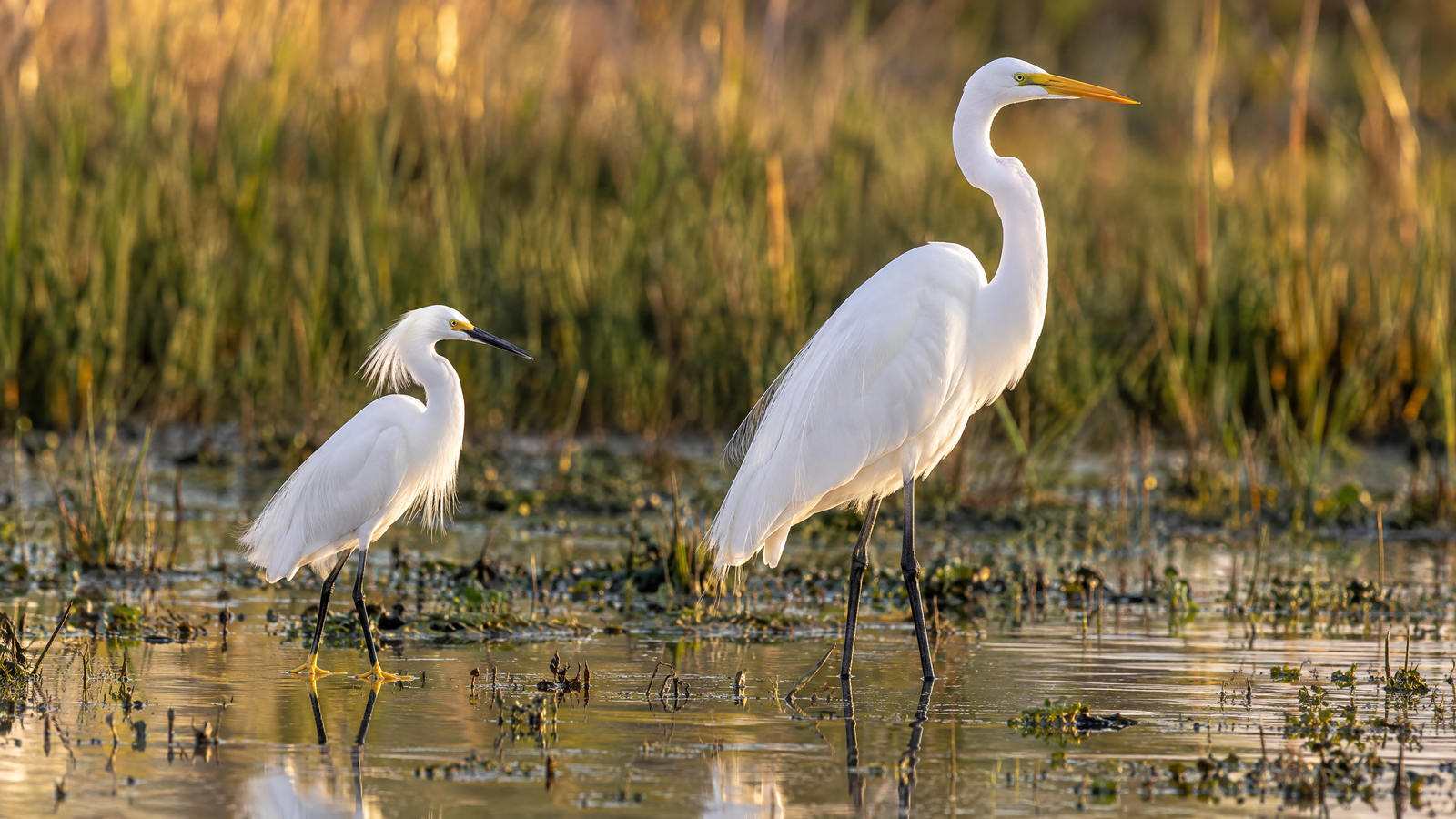
Have you ever spotted two beautiful white egrets standing in a wetland and wondered whether they were Snowy Egrets or Great Egrets? At first glance, these birds look almost identical because both have completely white feathers, long necks, and slender legs. However, several important features make them easy to tell apart.
The easiest way to identify a Snowy Egret vs. Great Egret is to look at their size, bill color, and feet. An adult Snowy Egret is smaller, with a black bill, black legs, and bright yellow feet. A Great Egret is much larger and usually has a yellow bill with entirely black legs and feet.
These two elegant wading birds live in similar wetland environments across North America. In this guide, you will learn how to recognize each species, compare their physical features, understand their behavior, and identify them in the field.
Quick Answer: Snowy Egret vs. Great Egret
The Snowy Egret and Great Egret are both members of the heron family (Ardeidae), but they differ noticeably in size and appearance.
Here are the most important identification clues:
- Snowy Egret: Smaller body, black bill, black legs, and bright yellow feet.
- Great Egret: Larger body, yellow bill, black legs, and black feet.
- Snowy Egret size: Approximately 22–26 inches long.
- Great Egret size: Approximately 37–41 inches long.
- Snowy Egret behavior: Often moves actively through shallow water while hunting.
- Great Egret behavior: Frequently stands still before striking at passing prey.
If you remember just one thing, look at the bill and feet. A black bill with yellow feet usually indicates a Snowy Egret, while a yellow bill and black feet indicate an American Great Egret.
1. Snowy Egret vs. Great Egret: Main Differences
The best way to distinguish these two birds is to compare several physical characteristics rather than relying on their white feathers alone.
| Identification Feature | Snowy Egret | Great Egret |
|---|---|---|
| Scientific name | Egretta thula | Ardea alba |
| Body size | Smaller | Much larger |
| Body length | 22–26 inches | 37–41 inches |
| Wingspan | About 39 inches | About 52–57 inches |
| Bill color | Black | Yellow |
| Leg color | Black | Black |
| Feet color | Bright yellow | Black |
| Body feathers | White | White |
| Neck | Slim and slender | Long and S-shaped |
| Hunting style | Often active | Often stands and waits |
| Typical habitat | Wetlands, beaches, marshes | Freshwater and saltwater wetlands |
Important identification note: These bill-color comparisons describe typical adult American Great Egrets. Great Egrets in some other parts of the world, particularly breeding populations in Asia and Australia, can have different seasonal bill colors.
2. Size and Body Shape
Size is one of the easiest ways to separate a Snowy Egret from a Great Egret, especially when both birds are standing close together.
How Big Is a Snowy Egret?
The Snowy Egret is a medium-sized wading bird with a slender body, narrow neck, and relatively small head.
Typical adult measurements include:
- Length: 22.1–26 inches
- Wingspan: Approximately 39.4 inches
- Weight: Approximately 13.1 ounces
Its lightweight body and delicate proportions make it appear graceful while walking through shallow water.
How Big Is a Great Egret?
The Great Egret is considerably larger and taller than the Snowy Egret. It has a longer neck, larger body, and heavier bill.
Typical adult measurements include:
- Length: 37–40.9 inches
- Wingspan: Approximately 51.6–57.1 inches
- Weight: Approximately 35.3 ounces
When the two species stand side by side, the Great Egret looks noticeably taller and heavier.
Identification tip: If you see a very tall white egret with a long neck and large body, it is more likely to be a Great Egret.
3. Bill Color: One of the Easiest Identification Clues
The bill is one of the most useful features when comparing these two species.
Snowy Egret Bill
Adult Snowy Egrets have a long, thin black bill. The bill looks narrow and pointed, making it useful for catching small fish and aquatic animals.
They also have a small patch of yellow skin between the bill and the eye.
Great Egret Bill
The typical adult American Great Egret has a long, straight, yellowish-orange bill. It is noticeably heavier than the Snowy Egret’s bill.
The yellow bill creates a strong contrast against its completely white head and body.
Quick identification trick:
- Black bill = Snowy Egret.
- Yellow bill = Great Egret (typical American adult).
Remember that breeding plumage and geographic variation can affect bill color in some Great Egret populations, so check other features too.
4. Leg and Feet Color
Feet and leg colors provide another excellent way to identify these birds.
Snowy Egret’s Black Legs and Yellow Feet
The adult Snowy Egret has black legs and bright yellow feet. Its yellow feet are sometimes called golden slippers because they stand out against the dark legs.
These colorful feet are particularly easy to notice when the bird walks through shallow water.
Snowy Egrets sometimes use their bright feet to stir up mud and disturb small aquatic animals, making them easier to catch.
Great Egret’s Black Legs and Feet
The Great Egret has entirely dark legs and feet. Unlike the Snowy Egret, it does not have bright yellow feet.
Its long black legs help support its tall body as it moves through marshes, ponds, and other wetland environments.
Remember this simple rule: Both species have black legs, but the Snowy Egret has yellow feet while the typical American Great Egret has black feet.
5. Feather Appearance and Breeding Plumage
Both birds have beautiful white feathers throughout the year, but their breeding plumage provides additional identification clues.
Snowy Egret Breeding Plumage
During the breeding season, adult Snowy Egrets develop delicate, wispy ornamental feathers on their heads, necks, and backs.
These feathers create an elegant, flowing appearance. Their facial skin can also become more colorful during courtship.
The long, delicate plumes are among the most recognizable features of a breeding Snowy Egret.
Great Egret Breeding Plumage
Great Egrets also develop long ornamental feathers during the breeding season.
Their long, delicate back plumes extend beyond the body and are especially noticeable when the bird displays or moves.
Breeding American Great Egrets may also develop green facial skin around the base of the bill, while their bill can become darker.
Identification tip: Do not depend only on breeding feathers. Both species develop decorative plumes, so check body size, bill color, and feet.
6. Habitat: Where Do Snowy Egrets and Great Egrets Live?
Both species depend on shallow-water environments where they can find fish and other small aquatic animals.
However, their preferred habitats and geographic distributions can vary.
Snowy Egret Habitat
Snowy Egrets are commonly found in:
- Coastal marshes
- Mudflats
- Shallow ponds
- Saltwater wetlands
- Freshwater marshes
- Beaches and estuaries
- Wet agricultural fields
In the United States, they are particularly associated with coastal wetlands, although they also occur in inland habitats.
Snowy Egrets often search for food in shallow water where small fish, insects, and other aquatic animals are available.
Great Egret Habitat
Great Egrets occupy a wide variety of freshwater and saltwater environments.
Common habitats include:
- Lakes and ponds
- Marshes and swamps
- Coastal wetlands
- Rivers and streams
- Estuaries
- Shallow flooded fields
- Wetland restoration areas
Great Egrets are widely distributed and can be seen across much of the United States.
They often forage in shallow water where fish and other prey are easy to spot.
7. Feeding Habits and Hunting Behavior
Although both birds eat similar types of food, their hunting techniques can look quite different.
What Do Snowy Egrets Eat?
Snowy Egrets are active hunters that feed on a variety of small aquatic animals.
Their diet includes:
- Small fish
- Frogs and tadpoles
- Aquatic insects
- Crustaceans
- Small aquatic invertebrates
Snowy Egrets often move through shallow water while hunting. They may run, shuffle their feet, flick their wings, or disturb the water to make prey move.
Their bright yellow feet can help stir up the bottom and reveal hidden food.
What Do Great Egrets Eat?
Great Egrets are opportunistic predators that mainly feed on fish but also eat:
- Frogs
- Crustaceans
- Aquatic insects
- Small reptiles
- Small mammals
- Other aquatic animals
Their hunting technique often involves standing motionless in shallow water and watching for prey.
When a fish or other animal comes within reach, the Great Egret quickly extends its long neck and strikes with its sharp bill.
Main difference: Snowy Egrets are often more energetic while hunting, whereas Great Egrets frequently use a patient, wait-and-strike approach. Both species can use different techniques depending on the situation.
8. Flight Differences
Watching these birds fly can provide additional clues for identification.
Snowy Egret in Flight
Snowy Egrets fly with their necks folded back and their legs extending behind their bodies.
Their smaller body and narrower wings create a relatively delicate appearance.
Their yellow feet may be visible beyond the tail, making them a useful identification feature.
Great Egret in Flight
Great Egrets also fly with their necks folded into an S-shape and their legs trailing behind.
However, their larger bodies and broader wings make them appear more substantial in the air.
When watching a large white egret flying over a wetland, its overall size and long trailing legs can help distinguish it from smaller species.
9. Nesting and Breeding Behavior
Snowy Egrets and Great Egrets both nest in colonies, sometimes alongside other herons and wading birds.
Snowy Egret Nesting
Snowy Egrets generally build their nests in trees, shrubs, or thick vegetation, often in protected wetland areas and on islands.
Their nests are made from small sticks, twigs, grasses, and other plant material.
Both parents participate in caring for their young.
Great Egret Nesting
Great Egrets usually build stick nests high in trees or shrubs, often in colonies with other waterbirds.
They prefer nesting areas that provide suitable vegetation and protection from land predators.
Both parents help incubate the eggs and feed the chicks.
Nesting locations and timing can vary depending on geography, weather, and local conditions.
10. Are Snowy Egrets and Great Egrets Found in the Same Place?
Yes! These two species can share the same wetlands, marshes, lakes, and coastal environments.
It is possible to see a Snowy Egret feeding near a Great Egret in the same shallow-water area.
However, their different body sizes, bills, and feet make them relatively easy to identify when observed closely.
When both species are present, comparing their size is particularly helpful.
A Snowy Egret will usually look smaller and more delicate, while a Great Egret will appear much taller and heavier.
11. How to Identify a Snowy Egret vs. Great Egret in the Field
If you are a beginner birdwatcher, you do not need professional equipment to distinguish these species.
Follow these simple steps:
Step 1: Check the Overall Size
Look at the bird’s height and body proportions. A Great Egret is significantly larger than a Snowy Egret.
Step 2: Look at the Bill
Check the bill color carefully. An adult Snowy Egret usually has a black bill, while an American Great Egret typically has a yellow bill.
Step 3: Observe the Feet
Look for bright yellow feet. This is one of the strongest identification clues for an adult Snowy Egret.
Step 4: Examine the Body Shape
Snowy Egrets have a smaller, more delicate appearance. Great Egrets have a much taller body and longer neck.
Step 5: Watch Their Hunting Behavior
A Snowy Egret may move actively through the water, while a Great Egret often stands still before striking at prey.
Step 6: Take a Photograph
If you cannot identify the bird immediately, take a photograph from a safe distance. Zooming in on the bill and feet can help you confirm its identity.
12. Why Are Snowy Egrets and Great Egrets Important?
Both species play valuable roles in wetland ecosystems.
They help regulate populations of small fish, amphibians, insects, and other aquatic animals.
Their presence can also make wetlands more interesting for birdwatchers, photographers, and nature enthusiasts.
Healthy wetland environments provide important feeding and nesting areas for many different bird species.
Protecting marshes, rivers, coastal habitats, and other wetlands helps support these beautiful birds and the wildlife that shares their environment.
Frequently Asked Questions
1. What is the main difference between a Snowy Egret and a Great Egret?
The biggest differences are size, bill color, and feet. Snowy Egrets are smaller and have black bills, black legs, and yellow feet. Great Egrets are larger and typically have yellow bills with black legs and feet in the United States.
2. Which bird is bigger, a Snowy Egret or a Great Egret?
The Great Egret is much bigger. It measures approximately 37–41 inches long, while the Snowy Egret measures approximately 22–26 inches.
3. Do Snowy Egrets have yellow feet?
Yes. Adult Snowy Egrets have bright yellow feet and black legs. Their colorful feet are one of their most recognizable identification features.
4. Do Great Egrets have black or yellow feet?
Typical American Great Egrets have black legs and black feet. Their yellow bill is another important identification feature.
5. Do Snowy Egrets and Great Egrets live in the same habitat?
Yes. Both species can live in coastal marshes, freshwater wetlands, ponds, estuaries, and other shallow-water environments.
6. Are Snowy Egrets and Great Egrets related?
Yes. Both belong to the heron family, Ardeidae. However, they belong to different genera: Snowy Egrets are Egretta thula, while Great Egrets are Ardea alba.
7. What do Snowy Egrets and Great Egrets eat?
Both species eat fish, frogs, insects, crustaceans, and other small aquatic animals. Snowy Egrets often use active hunting techniques, while Great Egrets frequently wait for prey before striking.
8. Do Snowy Egrets and Great Egrets change color during breeding season?
Both species develop decorative breeding plumes. Their bare facial skin and bill colors can also change seasonally. These changes are why birdwatchers should use multiple identification features rather than relying on one characteristic.
Conclusion: How to Tell a Snowy Egret vs. Great Egret Apart
Identifying a Snowy Egret vs. Great Egret becomes much easier when you know what to look for.
The Snowy Egret is smaller, with a black bill, black legs, and bright yellow feet. The Great Egret is much larger, with a yellow bill and black legs and feet in its typical American adult plumage.
Both species are beautiful wetland birds that play important roles in their ecosystems. Whether you spot them near a lake, coastal marsh, pond, or river, observing their size, bill color, feet, and hunting behavior will help you identify them with confidence.
Want to learn more about beautiful white wading birds? Explore more bird identification guides on Birdiy.com and discover the amazing wildlife found across North America.